
How to Search Lafayette County Court Records
Lafayette County spreads its records across several courts, so the first step is matching the case to the right office. Circuit and County Court cases can be looked up through the Delta Computer Systems case search for Lafayette County. That portal labels the county plainly and charges per page for documents. It also carries a key warning. Circuit and County Court record updates ended on February 26, 2024. The online file is useful for older or previously posted cases. It should not be treated as the only source for anything current.
Chancery cases follow a different path. Divorce, probate, guardianship, and land matters moved to Mississippi Electronic Courts, so the older chancery lookup now points searchers back to the Chancery Office. For current, certified, sealed, or non-digitized files, the clerk who holds the record is the fastest route.
The county's official government homepage links every court office and department in one place, which helps before any lookup begins. You can see that landing page on the Lafayette County government homepage.

Confirming which Lafayette County office keeps a record there saves a wasted trip or call. A short, ordered routine works for most searches.
- Identify the court. Felony, major civil, or appeal matters start with the Circuit Clerk. Divorce, probate, guardianship, and land title start with the Chancery Clerk. Sheriff, university, or highway-patrol tickets start with Justice Court, and Oxford Police citations start with Oxford Municipal Court.
- Try the matching online source. Use the Delta Circuit and County search for legacy court cases, and the Oxford docket link for city cases.
- Read the posted notices first. The Delta circuit page says updates stopped in early 2024, and the chancery page says records moved to the state e-filing system.
- Call the clerk for current, certified, older, or restricted records when the portal comes up short.
- File a public-records request for county documents that are not online, and use the City of Oxford portal for police and municipal records.
Note: Online court data in Lafayette County can lag the clerk counter, so confirm any date, charge, or disposition with the office that holds the file.
The Lafayette County Judicial System
Mississippi builds its courts in tiers. At the top sit the state Supreme Court and the Court of Appeals. Below them, Lafayette County uses Circuit, Chancery, County, Justice, and Municipal courts. Circuit Court is the main law-side trial court for felonies and larger civil suits. It also hears appeals from the lower county and city courts. Lafayette County belongs to the Third Circuit Judicial District, which also serves Benton, Calhoun, Chickasaw, Marshall, Tippah, and Union counties.
County Court is the newest layer. It became effective January 1, 2023, after the county passed 50,000 residents in the 2020 Census. Judge Tiffany Kilpatrick was elected as the first County Court judge. The court handles youth court, eminent domain, civil cases up to $200,000, and appeals from Justice and Municipal courts. Chancery Court runs the equity side, covering divorce, custody, wills, guardianships, and land title.
The Mississippi Judiciary publishes a plain overview of how these courts fit together, shown on the state court structure page.
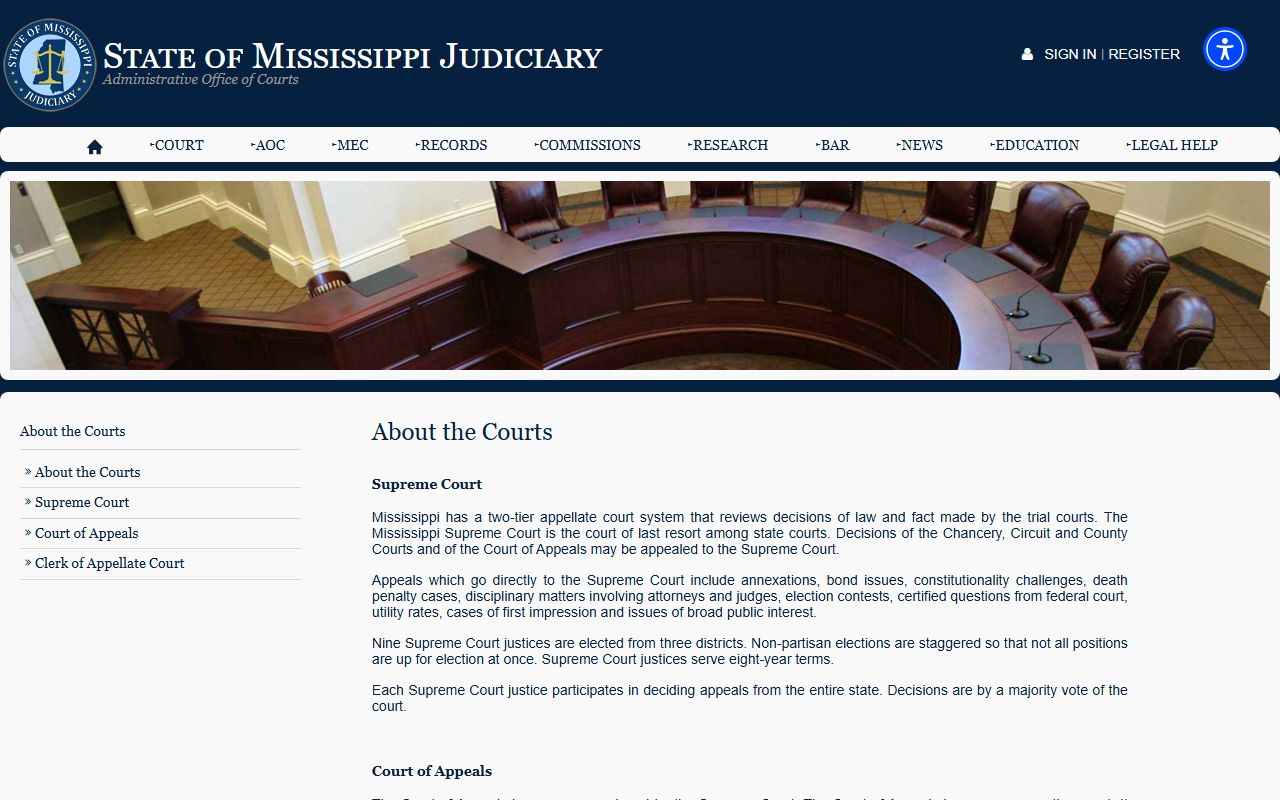
That overview confirms the same ladder cases climb when they are appealed in Lafayette County.
Case flow: Justice Court / Municipal Court › County Court › Circuit Court › Court of Appeals › Supreme Court
| Court | Jurisdiction | Case Types |
|---|---|---|
| Circuit Court | Main law-side trial court | Felonies, major civil suits, lower-court and agency appeals |
| County Court | Limited trial court | Youth court, eminent domain, civil up to $200,000, appeals |
| Chancery Court | Equity and family court | Divorce, custody, probate, guardianship, land title |
| Justice Court | Lower county court | Misdemeanors, traffic, civil under $3,500, felony preliminaries |
| Municipal Court | City court | City ordinances, Oxford Police citations, city warrants |
Lafayette County Courthouses
Court business in Lafayette County is split across three main buildings. The historic main courthouse on the Oxford Square holds Circuit Court, County Court, and the Circuit Clerk. The Chancery Courthouse a few blocks away holds Chancery Court and the Chancery Clerk. A separate business complex on the edge of town houses both Justice Court and Oxford Municipal Court. Knowing which door to use keeps a records visit short.
The courthouse on the Square has stood as a landmark since 1872, and its facility page is shown on the official courthouse page.

That page confirms the Square location and the standard weekday hours used by the clerks inside.
Circuit Clerk and Chancery Clerk Roles
Lafayette County uses a split clerk structure, and the divide trips up many searchers. The Circuit Clerk keeps Circuit and County Court case files, issues marriage licenses, and manages jury and election duties. Circuit Clerk Jeff Busby works from the main courthouse on the Square. The Chancery Clerk keeps Chancery Court files, land records, and Board of Supervisors minutes, and also serves as county auditor and treasurer. Chancery Clerk Mike Roberts works from the Chancery Courthouse on North Lamar.
Matching the record to the clerk is the whole game. A divorce decree or a will sits with the Chancery Clerk, while a felony file or a marriage license sits with the Circuit Clerk. The county's elected-officials directory lists both offices and their contacts, shown on the elected officials page.

That directory confirms who holds each seat and where each office sits.
| Circuit Clerk | Chancery Clerk |
|---|---|
| Circuit and County Court records | Chancery Court, probate, and land records |
| Marriage licenses | Board of Supervisors minutes |
| Jury and election duties | County auditor, treasurer, passports |
| 1 Courthouse Square, Suite 101 | 300 N. Lamar Blvd. |
| (662) 234-4951 | (662) 234-2131 |
Types of Court Records Available in Lafayette County
Court records in Lafayette County track the work of five trial courts plus the federal court in Oxford. The mix is broad. Criminal files run from city misdemeanors up to felony prosecutions in Circuit Court. Civil files cover debt, contract, property, and tort suits. Family and probate matters live in Chancery Court, while traffic cases split by the agency that wrote the ticket.
Which court produced a record tells you a lot about what it holds. The Mississippi Bar offers a plain-language guide to these court levels, shown on the Bar's court system page.
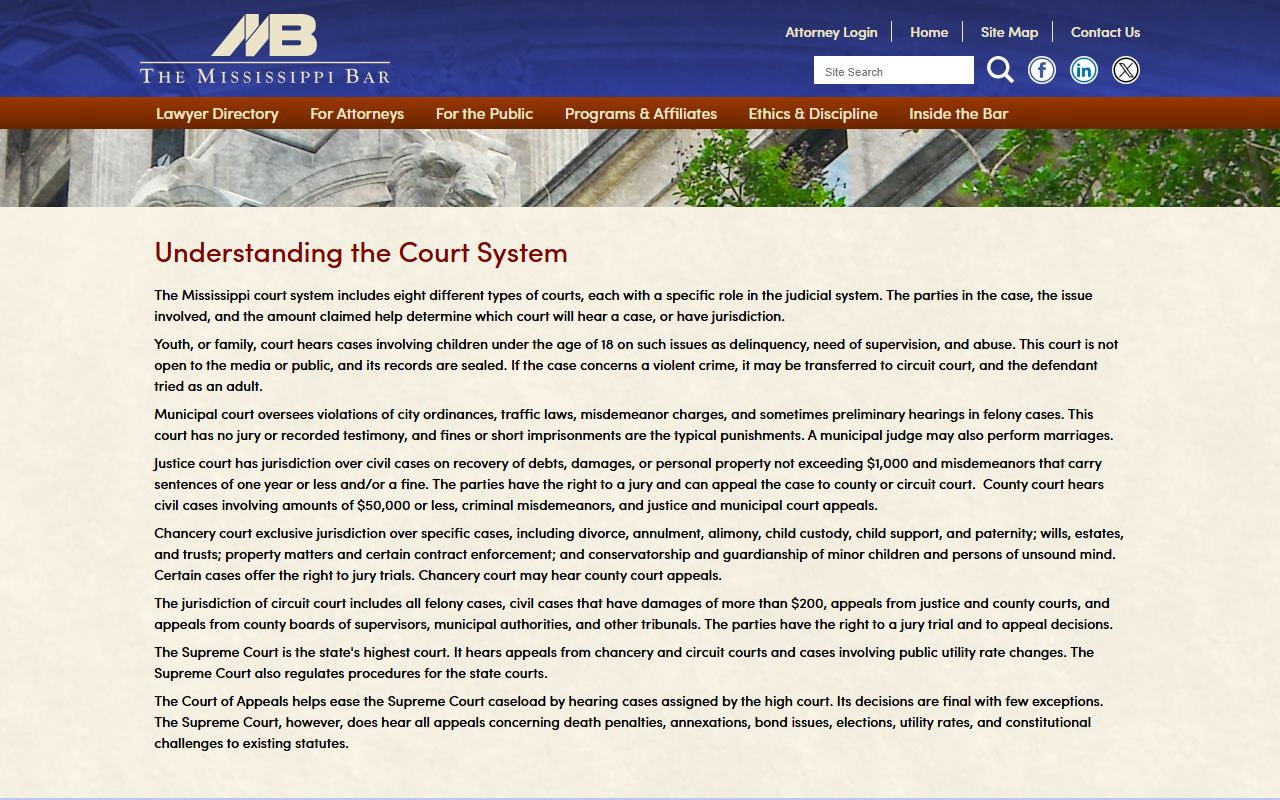
That guide pairs well with the local split of records below.
- Criminal records - charging documents, indictments, pleas, and sentencing orders from Circuit, County, Justice, and Municipal courts.
- Civil records - complaints, answers, motions, judgments, garnishments, and appeals from lower courts.
- Family and divorce records - divorce, custody, support, and protective-order files kept in Chancery Court.
- Probate records - wills, estates, guardianships, and conservatorships handled by the Chancery Clerk.
- Traffic records - citations, court dates, fines, and driving-school entries split between Justice and Municipal courts.
What Lafayette County Court Records Show
A court file is built from many small fields, and the same labels repeat across case types. The case number ties everything together. Party names, filing dates, charges, and the final outcome round out the core of most records. Criminal files add bond, plea, and sentence detail. Civil files add the cause of action and any money judgment.
Reading these fields in order makes a printout far easier to follow. The table below maps the common ones.
| Field | What It Shows |
|---|---|
| Case Number | The clerk's unique docket or file number for the case. |
| Filing Date | When the case or document entered the court record. |
| Parties | Plaintiff, defendant, petitioner, or respondent names as styled. |
| Charges / Cause | The criminal charge or the civil claim driving the case. |
| Disposition | The final outcome, such as guilty, dismissed, or judgment entered. |
| Sentence / Judgment | Fines, jail time, probation, restitution, or the money awarded. |
| Attorneys | Counsel of record with Mississippi Bar numbers where listed. |
Public Access Laws for Lafayette County Court Records
Mississippi treats public records as open by default. The state Public Records Act says records are available to inspect and copy unless a statute, court rule, or court order blocks access. Lafayette County follows that policy and publishes a request form for documents that are not posted online. Some files stay closed, though. Youth court records are confidential, and adoption, mental-health, sealed, and expunged matters are restricted or redacted.
The Public Records Act overview is hosted by the Mississippi Ethics Commission, shown on the official Public Records Act page.
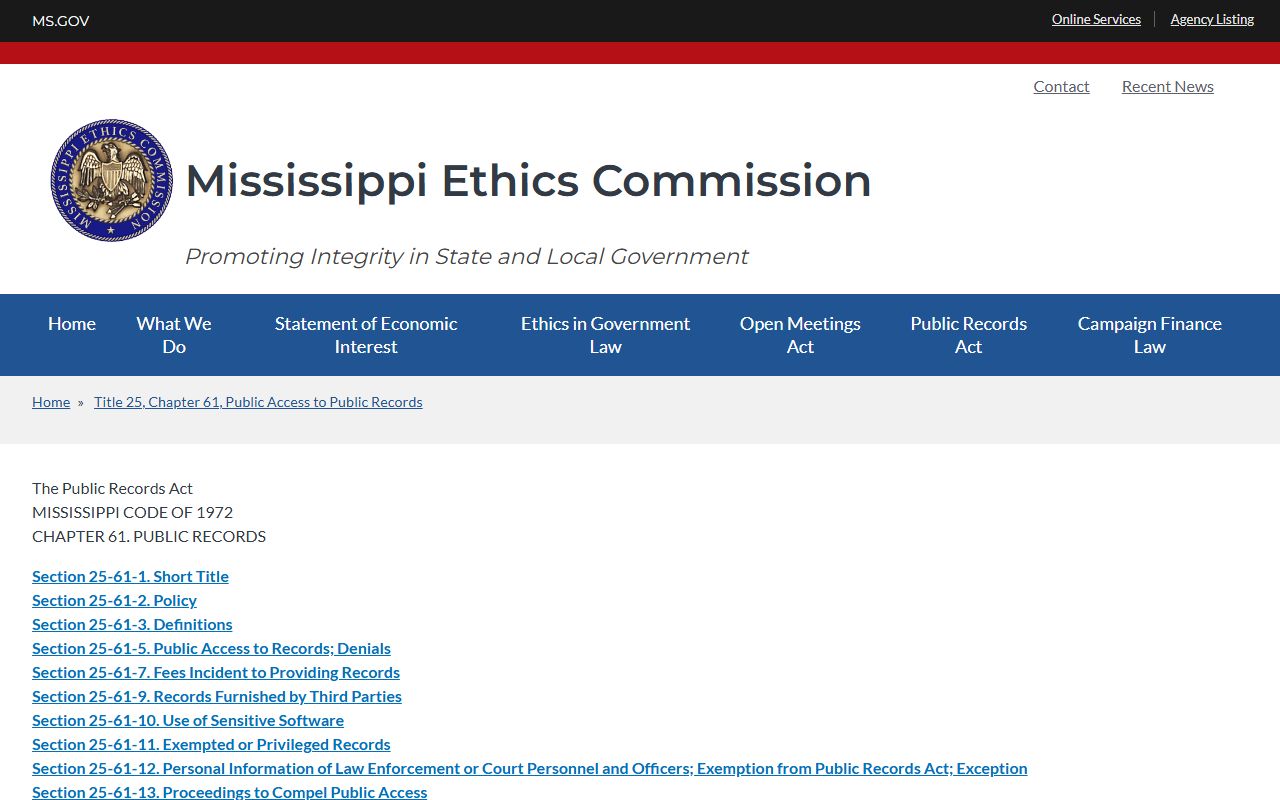
The statutes below shape what stays open and what is closed.
Key Statutes:
Mississippi Public Records Act, Title 25, Chapter 61 - public records are open for inspection and copying unless a specific law restricts them.
Miss. Code Ann. § 99-19-71 - governs which arrests, charges, and convictions may be expunged from public access.
Miss. Code Ann. § 43-21-251 - keeps youth court records confidential except as youth-court law allows.
Miss. Code Ann. § 91-7-322 - allows a small-estate affidavit to collect certain property without full probate.
Records That Are Restricted or Confidential
Open-records policy has firm limits in Lafayette County. Youth court files are confidential under state law, so a child's delinquency or abuse case will not appear in any ordinary public docket. Adoption files are closed to anyone outside the parties and the court. Mental-health and substance-abuse commitment files carry medical detail and are usually sealed or heavily redacted. Even open files commonly hide Social Security numbers, account numbers, and the names of minors.
Expunged records are a separate category. Once a judge signs an expunction order, the matter is removed from public view. The county public-records page explains the categories and links the request form, shown on the public records information page.
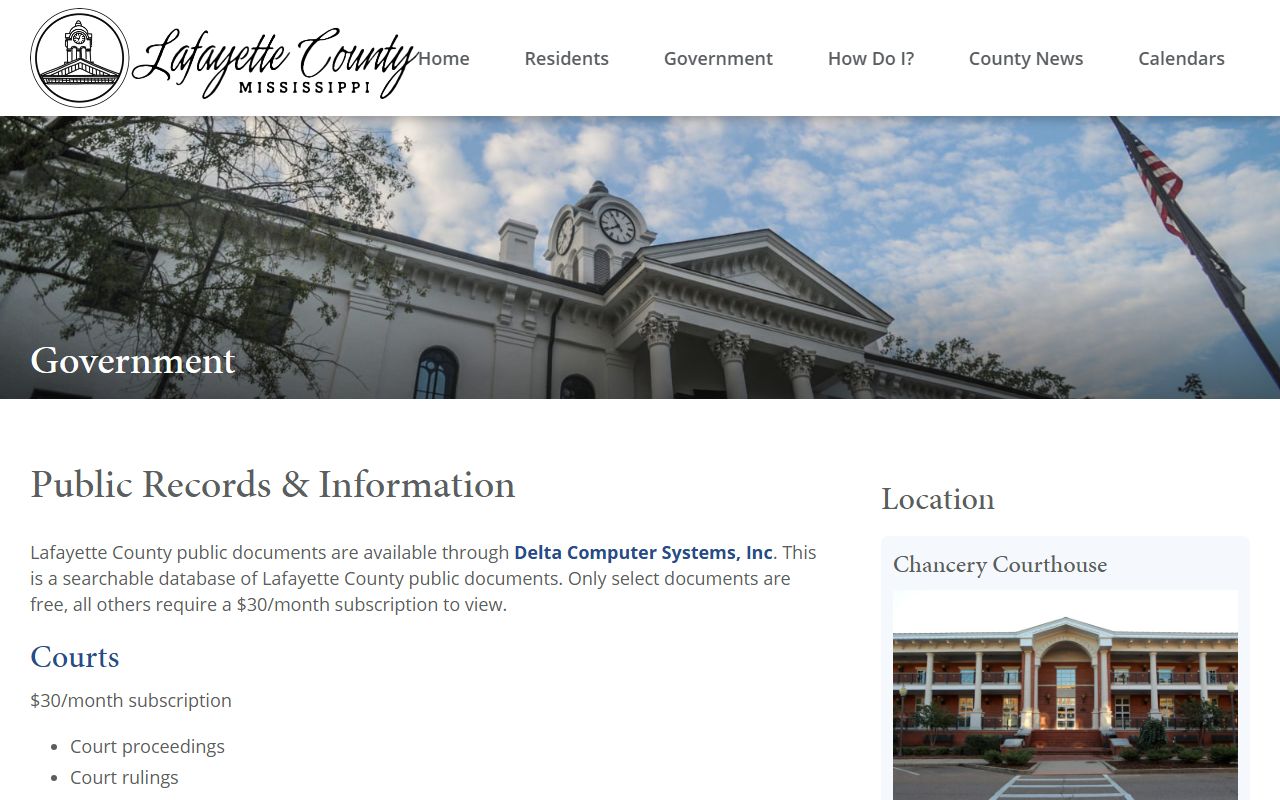
To view a sealed file, a person usually must be a party or hold a court order, so the clerk should be asked about the proper petition before any request.
Note: A record missing from an online portal is not proof it does not exist, since restricted, sealed, or older files often sit only at the clerk counter.
Specialty Courts in Lafayette County
Two specialty programs stand out locally. The Drug Intervention Court is the best documented. It is led by a Circuit Judge and serves all seven counties of the Third Circuit District, including Lafayette. The program focuses on rehabilitation rather than jail and hears only drug-related felony cases. A defendant enters only after the District Attorney recommends the case and the court staff approve it. Anyone who committed a violent crime alongside the drug offense loses the chance to take part.
Approved participants are sentenced to a treatment program lasting at least three years. They face random drug testing and must meet weekly for docket call. Those meetings are led by the judge and open to the public. The county says most charges are fully expunged after a participant completes the program.
Youth Court is the second program, run through County Court. It handles delinquency, abuse, and neglect cases involving children. Judge Tiffany Kilpatrick presides as the county's first elected County Court judge. Because youth court files are confidential, these cases never appear in the public case search, and questions should go straight to the County Court office.
Lafayette County Sheriff and Jail
The Lafayette County Sheriff's Department is led by Sheriff Joey East and runs the county jail. The department keeps the jail docket and handles custody, bond, and release questions by phone. The Lafayette County Detention Center sits just west of the Oxford Square on Jackson Avenue, with free visitor parking in front. There is no public online inmate roster on the county site, so the jail phone line is the accurate first stop for current custody status.
The department also runs an official mobile app, the Lafayette Co. Sheriff's Dept. app, on Apple and Google Play. It supports crime reporting, tips, and public-safety news, but the store listings do not confirm an inmate or warrant lookup inside it. For sentenced state inmates, the Mississippi Department of Corrections search covers people in state custody. The department's full page lists its leadership and jail contacts on the Sheriff's Department page.
Lafayette County Detention Center
711 Jackson Ave. East
Oxford, MS 38655
(662) 234-6421
Booking detail and the daily roster sit with the jail, so the full picture lives in the Lafayette County inmate records, while active orders for arrest are covered in the warrant records.
Marriage, Divorce, and Chancery Records
Family records in Lafayette County split between two offices. The Circuit Clerk issues marriage licenses and files the marriage record with the state. Divorce, custody, and support files belong to Chancery Court and sit with the Chancery Clerk. Probate work, including wills, estates, guardianships, and conservatorships, runs through the same chancery office. Current chancery cases now file through Mississippi Electronic Courts.
The Chancery Courthouse on North Lamar is the counter for divorce and probate copies, and its facility page is shown on the Chancery building page.

For deeper detail, the marriage and divorce records and probate records pages walk through fees and request steps. A few probate terms come up often.
- Testator
- A person who has made a valid will.
- Executor
- The person named in a will to settle the estate.
- Conservator
- Someone the court appoints to manage an adult's financial affairs.
- Intestate
- An estate where the person died without leaving a will.
- Guardianship
- A court appointment to protect a minor or an adult's care.
Lafayette County Court Records Fees
Copies and certifications carry set fees at the clerk offices. Circuit and County Court fees come from the county's published civil and criminal schedule. Plain copies run by the page, while certified copies and research carry their own charges. Marriage licenses and appeals have flat fees. Chancery probate filings follow a separate chancery fee list, so the Chancery Clerk should be called for those amounts.
| Item | Amount |
|---|---|
| Plain copy per page | $1.00 |
| Certified copy | $2.50 |
| Authentication of record | $5.00 |
| Records research fee | $10.00 |
| Circuit and County civil filing | $161.00 |
| Marriage license | $37.00 |
| Certified marriage license copy | $17.00 first, $5.00 second same day |
| Expungement | $150.00 or $161.00 by statute |
| Appeal to Supreme Court | $200.00 |
Note: The research fee and certified-copy charges are cash or money order in many cases, so confirm accepted payment with the clerk before a visit.
History of Lafayette County Courts
Court history in Lafayette County runs deep because the courthouse and the Oxford Square grew up together. The Mississippi Legislature organized the county on February 9, 1836, from Chickasaw cession land. Oxford was named the county seat that June, and the public square was marked off for a courthouse. The first courthouse was finished in 1840 under a contract awarded for $23,600.
The Civil War nearly erased it. On August 22, 1864, Union troops burned the courthouse, leaving only charred brick walls. A new building rose under a contract awarded in 1871, and it was ready for use by January 1873. That center section still anchors the courthouse today. The county history page traces the full timeline, shown on the official county history page.

Later work added east and west annexes in 1952 and a major renovation in 2007. The biggest recent change came on January 1, 2023, when County Court began after the county passed 50,000 residents. That growth is part of why older online files and newer County Court records can look different.
Frequently Asked Questions
Where do I search Lafayette County court cases online?
Circuit and County Court cases can be searched through the Delta Computer Systems case link for Lafayette County. The portal charges per page for documents and warns that record updates ended in February 2024. For chancery cases, the older online lookup now directs searchers to the Chancery Office because those records moved to the state e-filing system. Older or certified files come from the clerk who holds them.
Which clerk keeps which records?
The Circuit Clerk keeps Circuit and County Court files and issues marriage licenses. The Chancery Clerk keeps Chancery Court files, including divorce, probate, guardianship, and land records. Matching the record to the clerk is the fastest way to avoid a wasted trip. A felony or marriage license goes to the Circuit Clerk, while a divorce or will goes to the Chancery Clerk.
How do I find out if someone is in the county jail?
The county does not post a public online jail roster, so call the Lafayette County Detention Center at (662) 234-6421 for current custody, bond, and court-date status. Sentenced state inmates can be found through the Mississippi Department of Corrections search instead. The Sheriff's mobile app shares public-safety news but does not confirm an inmate lookup.
Are Lafayette County court records public?
Most court records are public under the Mississippi Public Records Act, which allows inspection and copying unless a law or court order blocks access. Youth court, adoption, mental-health, sealed, and expunged files are restricted. Public copies also redact Social Security numbers, account numbers, and the names of minors. The county offers a request form for records that are not online.
How do I get a certified copy of a court record?
Certified copies come from the clerk who holds the file. The Circuit Clerk handles Circuit and County Court records, and the Chancery Clerk handles chancery and probate files. A certified copy costs $2.50 at the circuit and county office, and a plain copy costs $1.00 per page. Call ahead to confirm the file is on hand and which payment methods are accepted.
Where do I pay or contest a traffic ticket?
Traffic cases split by the agency that wrote the ticket. Sheriff, University Police, and Highway Patrol citations go to Justice Court at (662) 234-1545. Oxford Police citations go to Oxford Municipal Court at (662) 232-2320. The municipal court asks people to call before paying online. If you are unsure who issued the ticket, call the number printed on the citation.
What happens if I have an outstanding warrant?
There is no official online warrant list for Lafayette County, so absence from a website proves nothing. Call the court tied to the case. Justice Court handles many bench and traffic warrants, Oxford Municipal Court handles city warrants, and the Sheriff's Department handles custody questions. Have a full name, date of birth, and any case number ready when you call.