
Criminal Court Records in Lafayette County
A criminal court record in Lafayette County is the case-level file a clerk opens when formal charges are filed. It is not the same as a booking sheet or an arrest log. The file holds the charging document, every motion and order, hearing dates, the plea, the verdict or negotiated outcome, and the sentence. Circuit Clerk Jeff Busby keeps the circuit and county court case files, while the courts drive what goes into them. Each entry is dated and tied to a case number, so the file reads as a running history of the prosecution. For the broader set of civil, family, and probate files, the same offices also maintain the county's general court records.
Mississippi spreads criminal jurisdiction across several courts, and the level of the charge decides where the case lives. The Circuit Court hears felony prosecutions and sits in the Third Circuit Judicial District, which covers Lafayette and six neighboring counties. The County Court, effective since 2023, can set bonds, issue search warrants, and conduct preliminary hearings. Justice Court and Oxford Municipal Court handle most misdemeanors, traffic offenses, and the early steps of felony charges before they reach the Circuit Court. A single arrest can touch more than one of these courts before it resolves.
Courts That Hear Lafayette County Criminal Cases
Where a record sits depends on the charge and the agency that brought it. Felony files concentrate in the Circuit Court, but lower courts open the earliest entries and keep their own dockets. The table below maps the criminal role of each Lafayette County court.
| Court | Criminal Role |
|---|---|
| Circuit Court | Felony prosecutions, jury trials, and sentencing in the Third Circuit District |
| County Court | Bonds, search warrants, preliminary hearings, and certain criminal matters |
| Justice Court | Misdemeanors, traffic, and felony charges before they move up |
| Oxford Municipal Court | City ordinance violations, state misdemeanors, and felony preliminary hearings |
Stages of a Lafayette County Criminal Case
A criminal case moves through fixed stages, and the court record grows at each one. Reading the docket in order shows how a charge turned into a final outcome. Some cases skip a trial entirely and resolve by plea.
Case flow: Charges Filed › Arraignment › Pretrial / Motions › Plea or Trial › Disposition › Sentencing
- Charges Filed
- An affidavit, citation, information, or grand-jury indictment opens the case and names the defendant.
- Arraignment
- The court reads the charges and the defendant enters a plea of guilty, not guilty, or no contest where allowed.
- Pretrial and Motions
- Lawyers file discovery requests, bond motions, and other requests, and the judge rules and sets dates.
- Plea or Trial
- The case ends in a negotiated plea or proceeds to a bench or jury trial for a verdict.
- Disposition and Sentencing
- The court records the final outcome, then any sentence, fines, restitution, or probation terms.
How to Search Lafayette County Criminal Court Records
The main online channel for circuit and county criminal cases is the Delta Circuit/County Court case search for Lafayette County. It offers a Case Type filter set to All, Civil, or Criminal, and it searches by party name, case number, and filing or disposition date. Documents are priced per page, and the page carries a key limit: the Circuit/County record update ended February 26, 2024. Treat it as a strong tool for historical cases, not a live feed.
- Open the Delta Circuit/County case search for Lafayette County.
- Enter a defendant name as Last, First, or type a known case number.
- Set the Case Type refinement to Criminal and add a filing date range.
- Open the matching case to read the docket, charges, and disposition.
- Request a certified copy from the Circuit Clerk for current or full files.
For active matters filed through Mississippi Electronic Courts, account-based access through MEC may apply. When a record is recent, sealed, or not online, the Circuit Clerk at (662) 234-4951 is the reliable fallback for copies and full case access.
What a Lafayette County Criminal Court Record Shows
A criminal case file reads field by field, and each line answers a different question. Together the fields trace the charge from accusation to sentence. The table below lists the core fields a Lafayette County criminal record usually carries.
| Field | What It Shows |
|---|---|
| Case Number | The unique docket identifier the clerk assigns when the case opens. |
| Defendant | The person charged, listed as styled in the case caption. |
| Court and Judge | Which court holds the case and the judge assigned to it. |
| Charges | Each count as filed, with the statute and severity level. |
| Bond | The amount and type set for release, plus any surety. |
| Plea | The defendant's response, such as guilty, not guilty, or nolo. |
| Disposition | The final outcome of each count. |
| Sentence | Jail or prison time, probation, fines, costs, and restitution. |
Reading Dispositions and Sentences
The disposition is the heart of any criminal record. It states how each charge ended, and the wording matters. A guilty plea and a guilty verdict both produce a conviction, while not guilty means acquittal. Dismissed, nolle prosequi, and no disposition all mean the charge did not become a conviction. A nolo or no-contest plea resolves the case without a formal admission, yet it can still carry a sentence.
The sentence reads just below the disposition. In Lafayette County felony files, it can pair prison time with probation, fines, court costs, and restitution to a victim. Watch for suspended time, which is held back as long as the defendant follows the terms. A deferred or nonadjudicated outcome can lead to dismissal once conditions are met, so the file may show a charge that never ripened into a conviction.
Note: Disposition language varies by court, so confirm an unclear entry with the clerk before treating it as a final conviction.
Charges vs. Convictions
Being charged is not the same as being convicted. A criminal court record can show charges that were dropped, dismissed, reduced, or that ended in acquittal. The presence of a charge proves only that a prosecutor accused someone, not that a court found guilt. For a closer look at how charges are filed and amended, the county's arrest and court charge records page follows that pathway.
| Charge | Conviction | |
|---|---|---|
| Stage | Accusation | Verdict or plea |
| Burden of Proof | Probable cause | Beyond reasonable doubt |
| Decided By | Prosecutor or grand jury | Judge or jury |
| Public Record | Yes | Yes |
The District Attorney's Charging Role in Lafayette County
Felony prosecution in the Circuit Court runs through the Mississippi Third Circuit District Attorney's Office, which serves Benton, Calhoun, Chickasaw, Lafayette, Marshall, Tippah, and Union counties. After an arrest or affidavit, lower courts may handle the first appearance, bond, and a preliminary hearing, but the felony case advances on the prosecutor's decisions. The DA presents cases to the grand jury, negotiates pleas, recommends diversion, and argues sentencing. Those choices shape almost every line that lands in a felony record.
The office publishes its team and contacts. A look at the Third Circuit DA attorney profiles shows the assistant district attorneys and staff assigned to Lafayette County prosecutions.
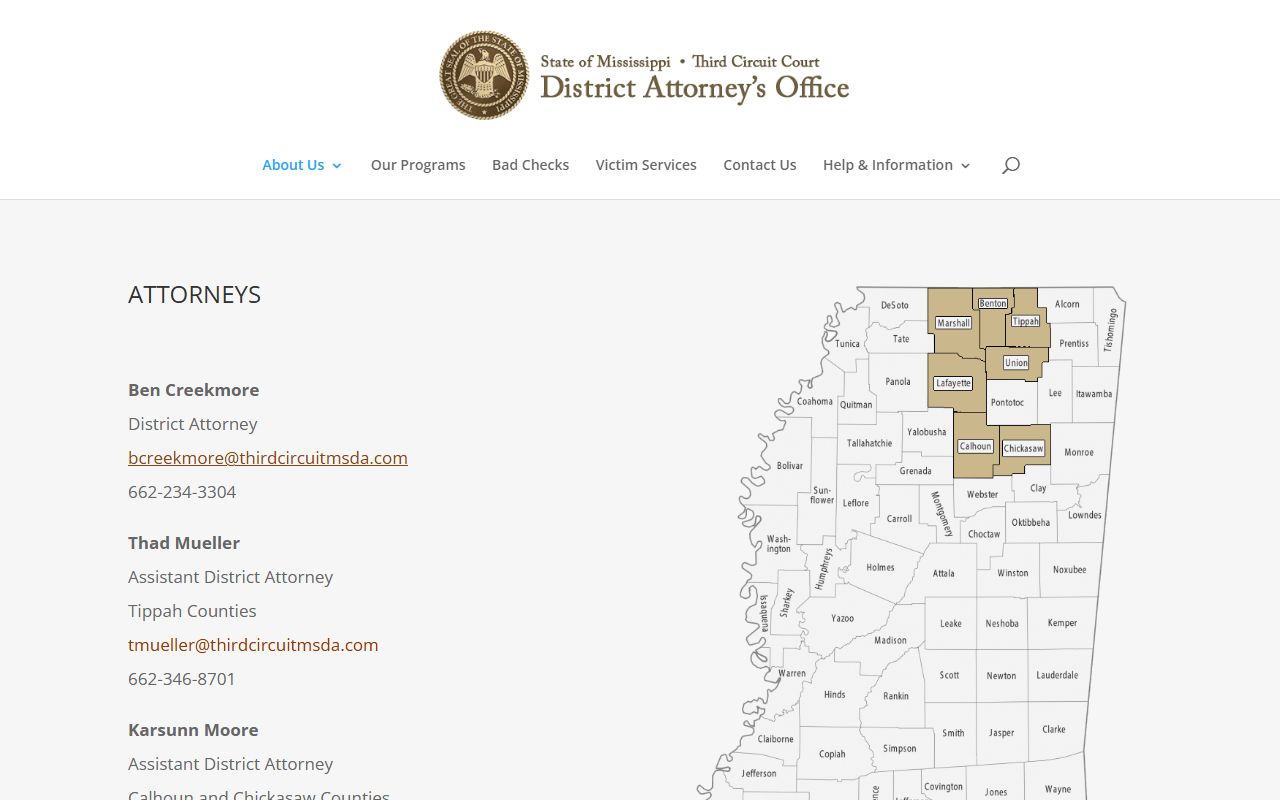
Those named prosecutors are the people who decide which charges move forward and which are reduced or dropped before trial. The office also keeps a public-facing home for case and contact information across the district.
The District Attorney's Oxford office is housed in a county facility at 1301 Monroe Avenue, the local base for felony prosecution.

Because the prosecutor controls felony charging, a record that shows an arrest but no Circuit Court case often means the matter is still under review.
Drug Intervention Court and Expungement
Lafayette County's Drug Intervention Court is the county's best-documented specialty court, and it changes how a record ends. The program hears only drug-related felony cases and focuses on rehabilitation instead of incarceration. A case reaches it only after the District Attorney recommends it and program staff approve. A defendant who committed a violent crime alongside a drug offense loses the chance to take part.
Participants are placed in a rehabilitation program for at least three years, submit to random drug testing, and meet weekly for docket call before the judge. The Third Circuit District program serves the same seven counties as the District Attorney's office. The county notes that on successful completion, most charges are completely expunged, which can clear them from a public criminal record.
The program runs under the broader Third Circuit prosecution structure. The Third Circuit District Attorney homepage anchors the office that recommends candidates into the program.
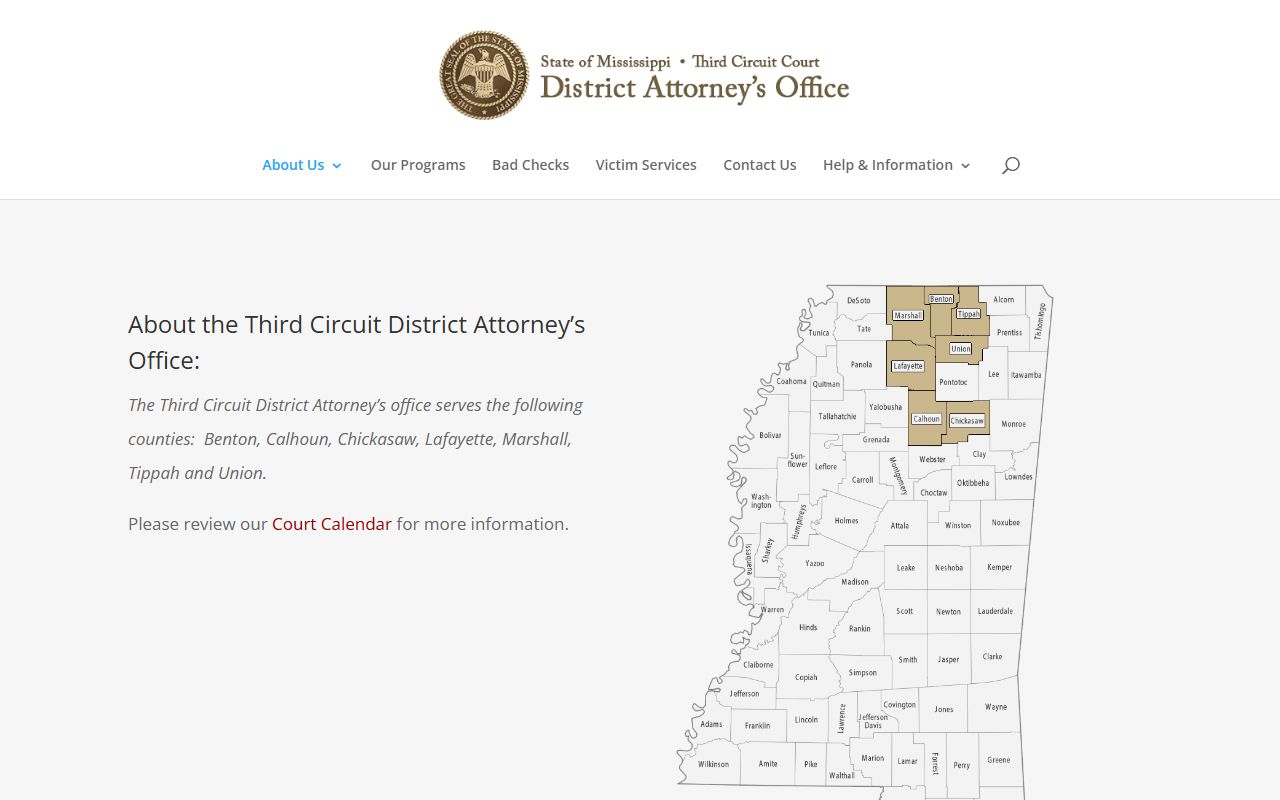
Because expungement follows completion, a former participant's record may show the case opening but not the final conviction that an ordinary felony track would leave behind.
Public Access to Lafayette County Criminal Records
Mississippi treats most court files as open. The Public Records Act sets a policy that public records are available for inspection unless a statute, rule, or court order restricts them. Criminal case files in the Circuit, County, Justice, and Municipal courts generally fall under that rule, which is why name and case searches return real dockets. Defendants who cannot afford a lawyer have a right to appointed counsel, and the statewide directory helps locate that office.
The Mississippi public defender directory from the Office of State Public Defender points felony defendants toward appointed counsel resources.
Appointed counsel appears in the case record as the defendant's attorney, so the file itself often shows whether a public defender was assigned.
Key Statutes:
Mississippi Public Records Act, Title 25, Chapter 61 makes public records open for inspection unless a law or court order says otherwise.
Miss. Code § 99-19-71 governs expunction for many non-convictions, first-offense misdemeanors, and some felony convictions.
Sealed vs. Expunged Records
Not every criminal record stays visible. A sealed record is hidden from public searches but still exists for limited official use. An expunged record is treated as if the case never happened, and it should not surface in a routine search. Mississippi expunction under Section 99-19-71 covers eligible non-convictions and certain offenses, subject to waiting periods and exclusions. Lafayette County's fee schedule lists expungement at $150, or $161 depending on the statute.
| Sealed | Expunged | |
|---|---|---|
| Visibility | Hidden from public | Treated as never existed |
| Law Enforcement | Limited access | Very limited access |
| Where to File | Court holding the case | Court of conviction or record |
| Eligibility | Youth and set-aside cases | Non-convictions and qualifying offenses |
Restricted Lafayette County Criminal Court Records
Some criminal matters never appear in a public docket. Youth court runs through the County Court, and Mississippi youth-court records are confidential under Miss. Code § 43-21-251. A court can seal a juvenile file when the person turns 20 or when a case is set aside. Searching an ordinary docket for a child's delinquency or abuse case will not work. Sealed adult cases, expunged charges, and ongoing investigations are likewise withheld, and public copies redact Social Security numbers, financial accounts, and minors' identities.
Federal criminal cases from Lafayette County follow a separate track. They are filed in the U.S. District Court for the Northern District of Mississippi, which holds court in Oxford, Aberdeen, and Greenville.
The Northern District of Mississippi federal court handles federal prosecutions that never enter the county's state-court dockets.
Federal dockets are searched through the federal PACER system, not the county clerk, so a missing state record may simply mean the case is federal.
Note: When a record does not appear in any public search, the case may be sealed, expunged, juvenile, or filed in federal court rather than the county system.